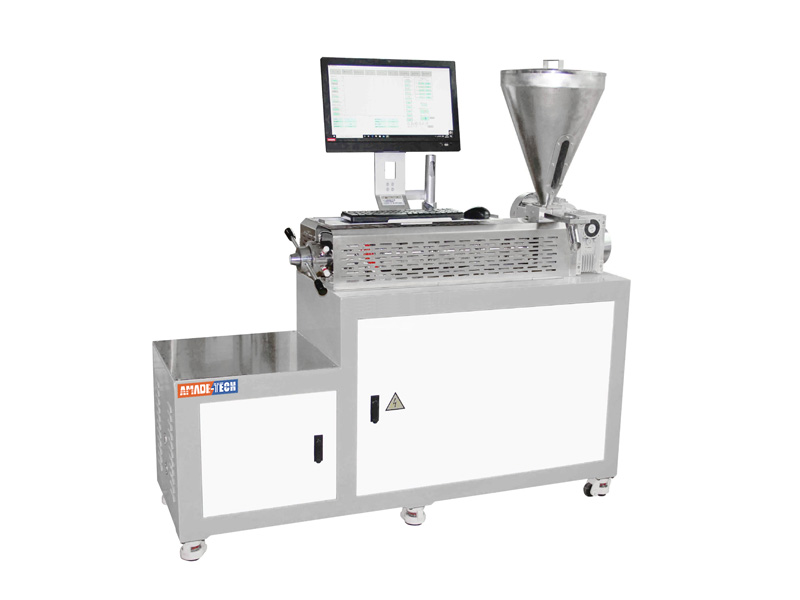

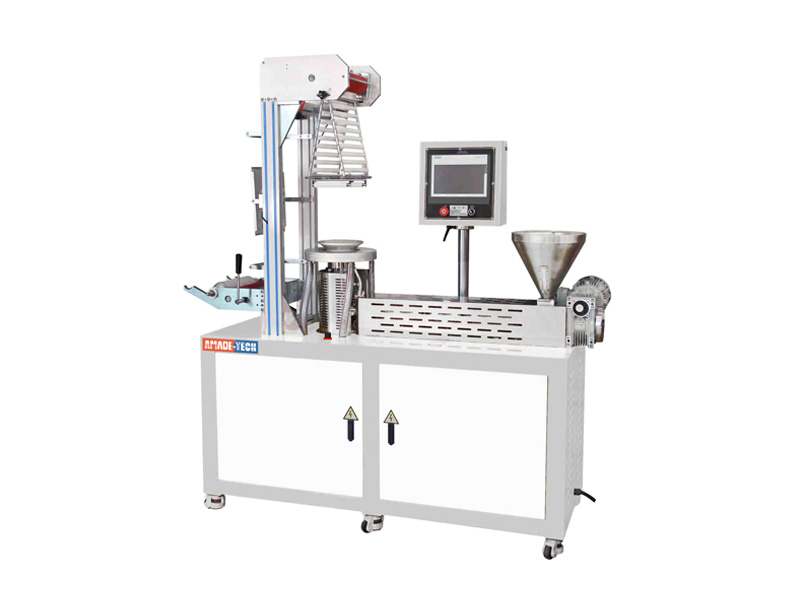
Monolayer Lab Blown Film Line China Supplier
A laboratory blown film machine is a miniature plastic film production line. This small, low-cost, and fully functional machine can blow a complete roll of film from a small amount of polymer plastic raw material. It is specifically used in laboratories to test the feasibility of blown film production of new materials and to understand the finished film’s properties such as transparency, strength, and toughness, optimizing formulations and production processes to establish optimal processing conditions for future mass production. In addition, the films blown by this machine can be used to make standard samples for testing mechanical strength (such as tensile strength and puncture resistance), barrier properties, and optical properties (such as light transmittance and haze). In short, a small blown film machine is an indispensable piece of equipment for laboratory research and development, pilot production, and quality testing of plastic products.
How the Blown Film Line Works
Solid plastic granules such as PE and PP are poured into the hopper of the extruder. As the screw rotates inside the barrel and the high-temperature environment provided by heating is utilized, the plastic material is heated, compressed, and sheared into a viscous melt, which is then extruded from a circular die at the other end to form a tubular plastic parison. Compressed air is blown out from the hole in the center of the die, inflating the freshly extruded hot plastic tubular parison like blowing up a balloon. At the same time, the traction roll at the top stretches the film longitudinally upward. The air ring around the die blows cold air upward around the bubble, allowing the film to cool and solidify rapidly, thus fixing the inflated shape and forming a large bubble. The cooled bubble is kept vertical and stable by a bubble stabilizer, then flattened by a collapsing frame, pressed and conveyed by the traction roll, and finally wound into a neat film roll by a take-up roll.
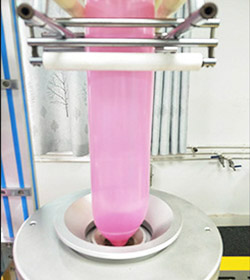
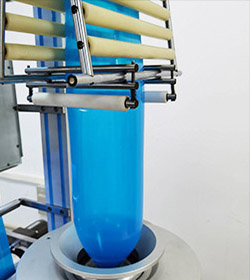
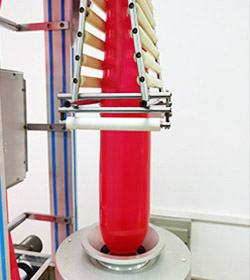
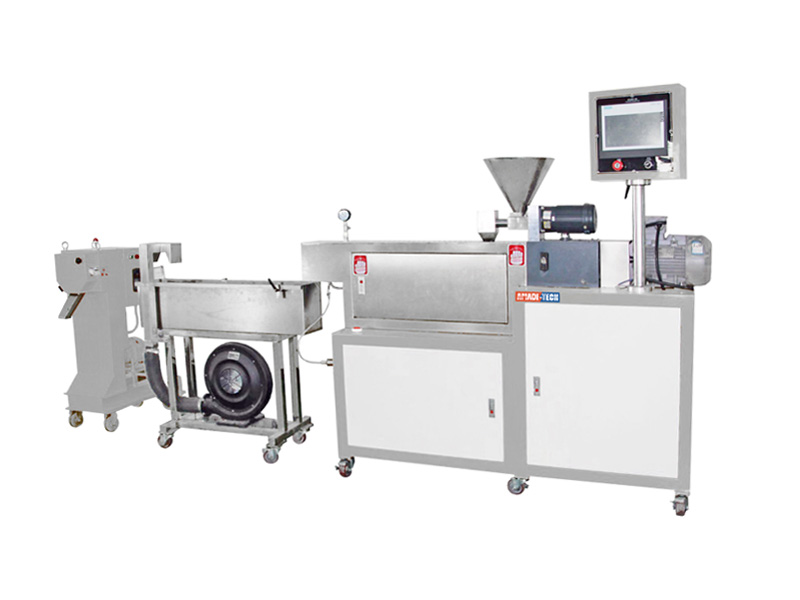
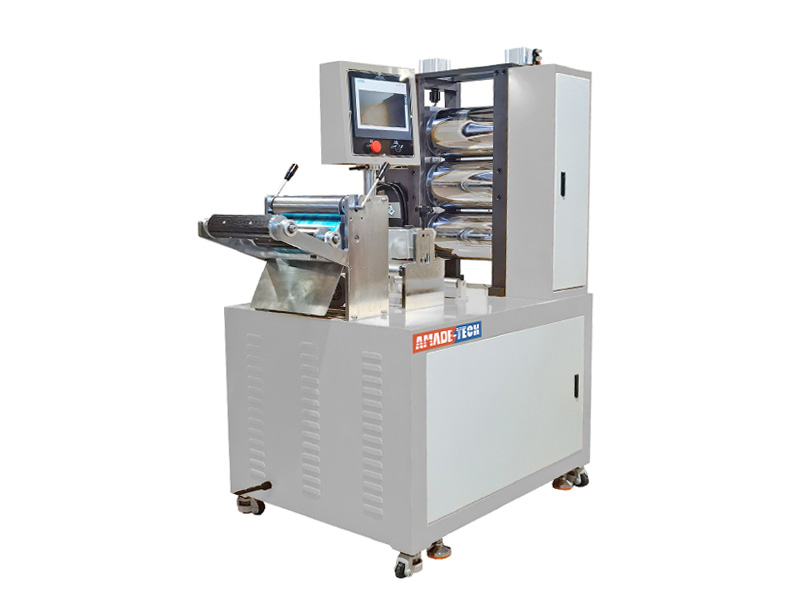
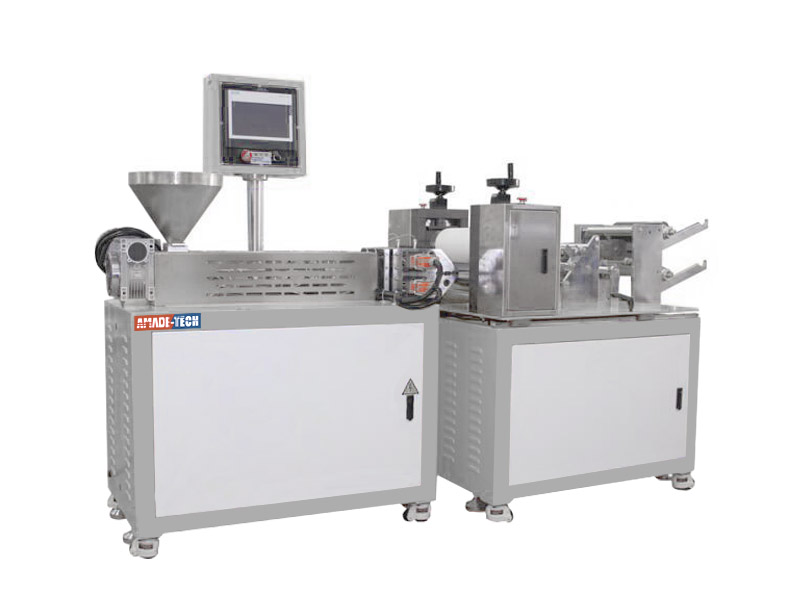
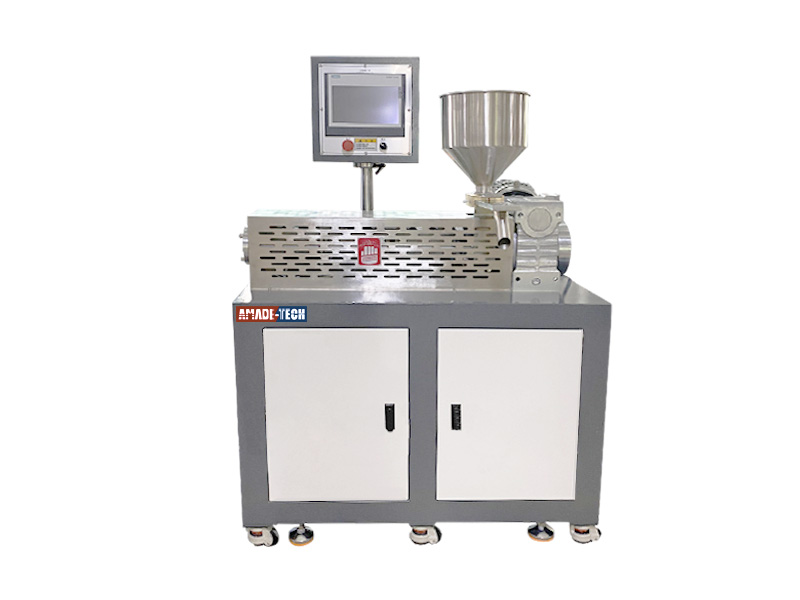
AmadeTech compact blown film line consists of a main frame, a single-screw extruder, a blown film unit, a cooling unit, and a winding unit, etc.
A Hopper Capable of Rapid Unloading
- Our blown film machine is equipped with a 10L stainless steel conical hopper.
- A long, transparent glass observation window is located on the conical bottom of the hopper, allowing you to easily monitor the material level during testing and replenish it as needed.
- The discharge port at the bottom of the hopper is fitted with a horizontally movable baffle. One end of the baffle has a hole with the same diameter as the discharge port, connected to a slanted, hollow, cylindrical stainless steel tube. When needed, simply push the bottom baffle to align the upper hole with the hole at the bottom of the hopper for quick material discharge.
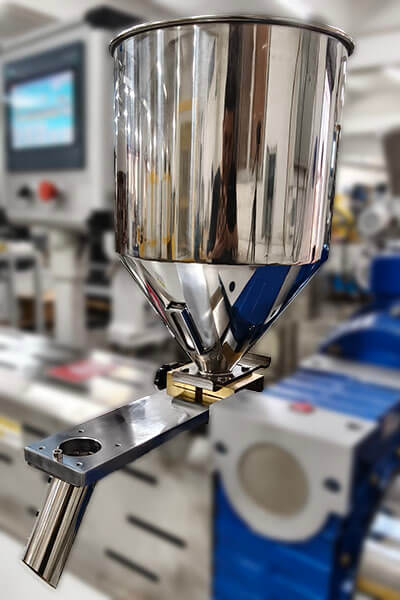
Stainless steel hopper
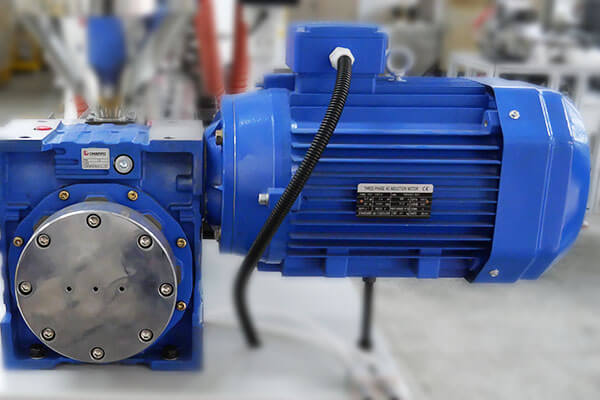
Drive motor
Powerful and Stable Drive
- The main power source of the AmadeTech blown film extrusion machine is a well-known 3.7kW variable frequency speed control motor, providing strong power to the extruder. The motor speed is controlled by a PLC via variable frequency speed control.
- It is equipped with a high-strength aluminum alloy transmission box, featuring an elegant appearance and excellent cooling performance. The drive motor is directly connected to the reducer, and the reducer’s output shaft is connected to the screw, driving the screw to rotate. This transmission device has a compact structure, operates smoothly, and can withstand high pressure.
A Precision Screw and Barrel Set
- The screw and barrel are key components of an extruder, responsible for the plasticization and extrusion of materials. Our machine’s barrel and screw are both made of high-quality nitrided steel 38CrMoALA, with a surface undergoing a gas nitriding treatment to a depth of 0.4~0.7mm. This results in high hardness, low roughness, excellent wear resistance, and corrosion resistance, significantly extending their service life.
- The screw speed can be freely adjusted within a specified range on the control panel to meet different processing requirements.
- The thread type, compression ratio, and length-to-diameter ratio can be customized according to the plastic material to be processed.
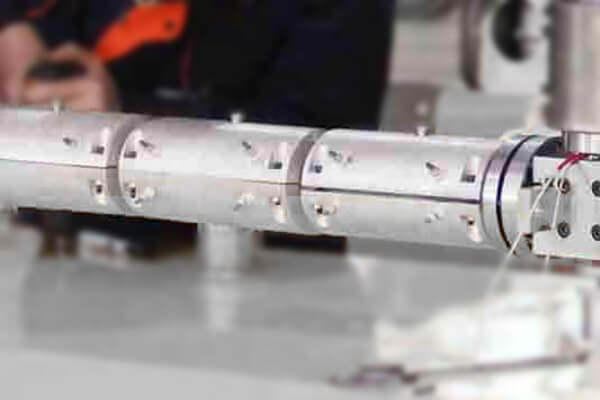
Extruder barrel
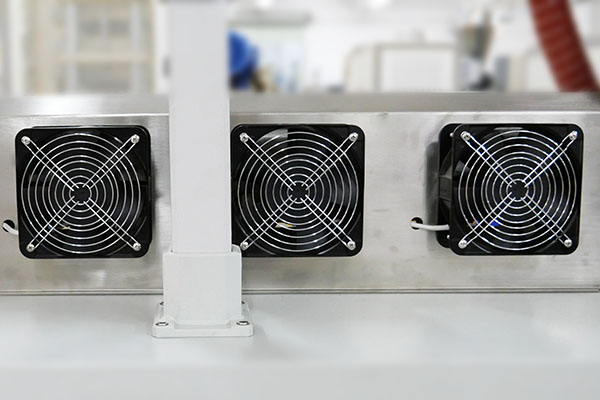
Cooling fans
Precise Heating and Cooling of the Barrel
- The barrel heating system utilizes the cast aluminum electric heaters, achieving a maximum heating temperature of 300 degrees Celsius. The machine’s barrel supports multi-zone heating, and the die head area also supports multi-zone heating. Temperature control for different zones is independent, freely adjustable, and does not interfere with each other.
- The barrel is encased in a stainless steel cover, ensuring uniform heat transfer, preventing heat loss, extending service life, and offering an aesthetically pleasing and energy-efficient design.
- The feed inlet section is equipped with a water-cooling system to prevent bridging, while other sections utilize multi-blade fans for efficient cooling of the processed material as needed.
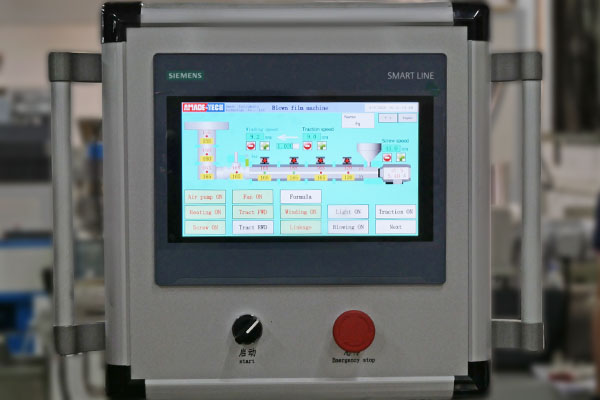
Touch screen
Intuitive and Easy-to-use PLC-based Touchscreen
- The machine’s controller adopts a German SIEMENS PLC programmable touch system, equipped with an advanced human-machine interface. The touchscreen allows for touch-based setting of the temperature in each zone of the barrel, screw speed, and traction roll speed, and can dynamically display and monitor units including temperature control, speed, drive, and pressure.
- The test page features various virtual buttons for controlling the screw rotation, compressed air, blower, traction roll, winding device, observation lights, and heating functions.
- English is supported as the operating language, enabling seamless switching between automatic and manual control functions, and interlocking control capabilities are included.
Customizable Blown Film Dies
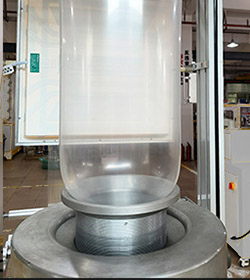
The die is the core component of the blown film machine. It has a precision annular die ring that extrudes molten plastic through a flow channel into a continuous, hollow cylindrical film embryo. The die is made of SCM440 alloy steel and undergoes heat treatment. The die uses a spiral flow channel, is chrome-plated and polished, achieving a precision of 0.02~0.04mm. Our machine’s standard blown film die diameter is 25mm. Other sizes can be customized based on the material’s expansion ratio and the desired bubble size.
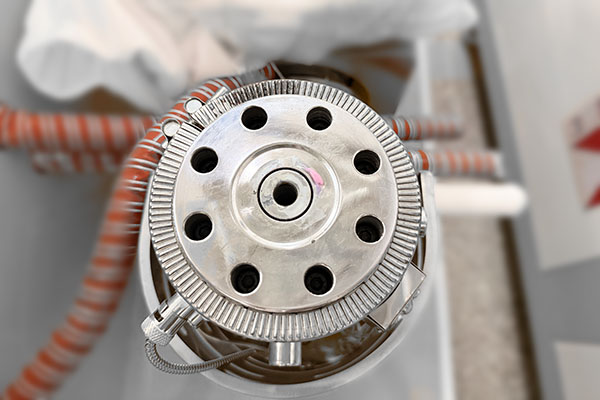
Film blowing die
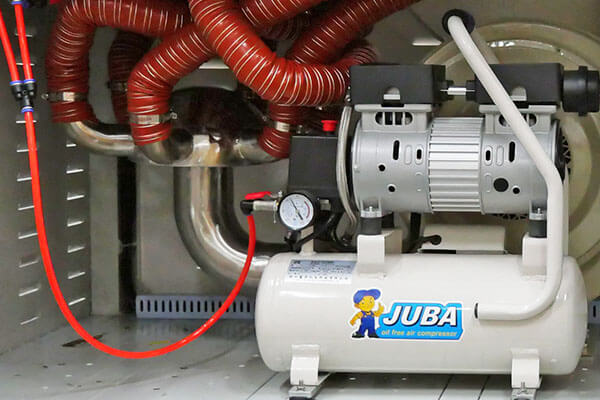
Air compressor & blower
Built-in Compressor & Blower
- Our film blowing machine has a built-in air compressor providing the necessary compressed air, eliminating the need for external compressed air supply. During operation, compressed air is blown upwards from the die orifice, expanding the tubular film embryo into a bubble of the specified thickness. The compressed air pressure is freely adjustable to control the size and thickness of the bubble.
- The machine also comes with a high-power blower that blows cold air. There is an air ring around the die head to blow out a 360-degree uniform ring airflow, which blows upward at a specific angle onto the bubble surface, so that the bubble that has just been extruded from the embryo can be cooled and stabilized immediately, and the bubble can be stably supported.
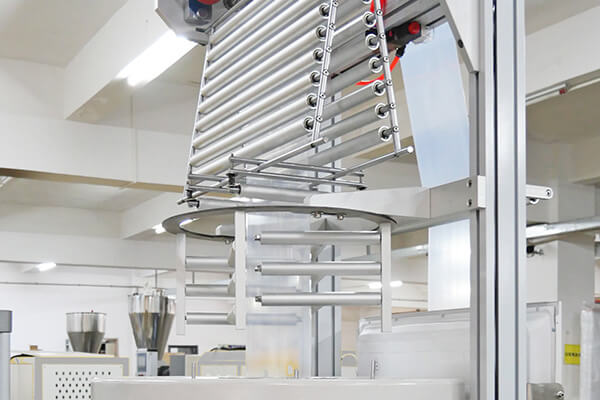
Bubble stabilizer
Bubble Stabilizer and Collapsing Frame
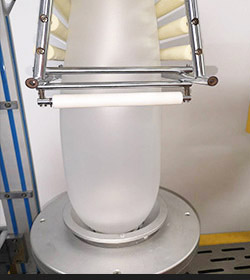
Our blown film machine’s bubble stabilizer and collapsing frame are made of aluminum alloy and can be freely adjusted as needed. As the film bubble is extruded and continuously pulled upwards, the bubble stabilizer is used to position and control the bubble’s center position to prevent deviation or wobbling, ensuring the bubble is blown smoothly. It is the last checkpoint ensuring the bubble’s verticality and stability before it transforms from a cylindrical shape to a flattened shape.
The collapsing frame above gradually flattens and folds the cylindrical film bubble rising from the bubble stabilizer into a flat double-layer film for feeding into the nip rolls.
Traction Rolls and Guide Rolls
The traction device is driven by an AC motor, allowing for stepless speed regulation to adapt to constantly changing extrusion speeds. The traction rolls support both forward and reverse rotation. Forward rotation is the normal operating state of the blown film machine’s traction rolls, responsible for the normal transport of the extruded film. Reverse rotation is an auxiliary function to meet specific process requirements or facilitate film pulling setup before blown film extrusion.
The blown film travels a considerable distance and undergoes changes in direction before reaching the take-up roll. Therefore, multiple guide rolls are needed to support, guide, and control the film, ensuring it reaches the next process smoothly and accurately. The guide rolls themselves are not powered; they rotate automatically due to friction with the film.
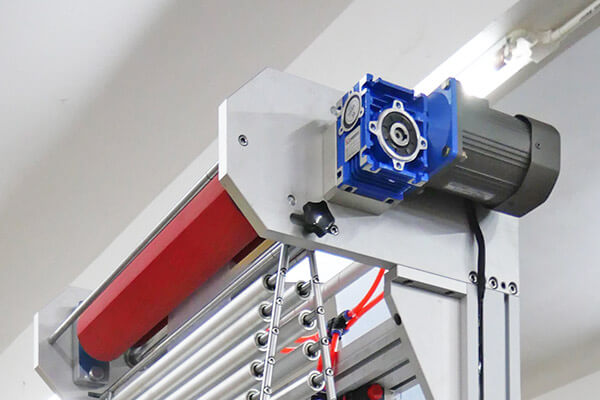
Traction roll
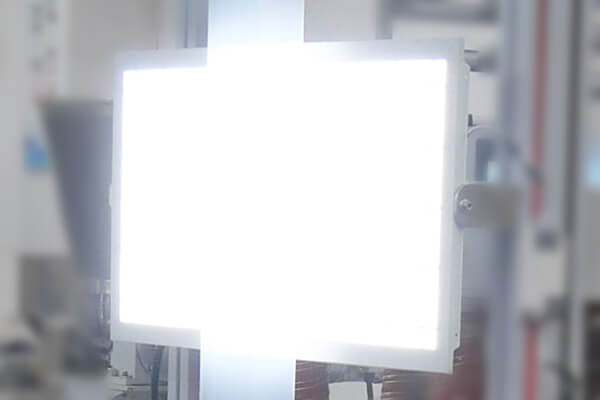
LED light
LED Observation Light
- We equip each blown film machine with a high-brightness LED flat panel observation light. It is installed vertically before the take-up process, allowing the film to pass uniformly in front of the light. When the light is on, it shines through the film, allowing you to immediately observe and understand whether the blown film has black spots, impurities, crystal points, and the dispersion of various components within the material, thereby reducing scrap rates and saving costs.
- The LED panel light can be easily turned on and off by tapping on the corresponding switch button on the touch control screen.
Standard Automatic Winding Unit
- The winding unit mainly consists of a rubber-made, power-driven active friction winding roll, a front driven blow-in shaft, and a rear driven auxiliary winding roll. Their lengths can be customized according to the film width. The outermost blow-in shaft is positioned on two inclined guide rails at both ends, allowing it to slide freely laterally. Under gravity, it remains at the bottom and leans against the active friction roll. The innermost metal roll is mechanically pressed against the active friction roll, achieving complete, gapless contact between the three rolls (shaft).
- The machine is equipped with an independent winding motor to drive the middle winding roll. When it rotates at a constant speed, it drives the roll and shaft on both sides to rotate together through friction, thus smoothly winding the film onto the paper tube fitted onto the blow-in shaft. As winding progresses, the film roll becomes larger, but the contact method with the active friction roll ensures that the tension on the film does not change drastically with the increased roll diameter, resulting in stable winding quality.
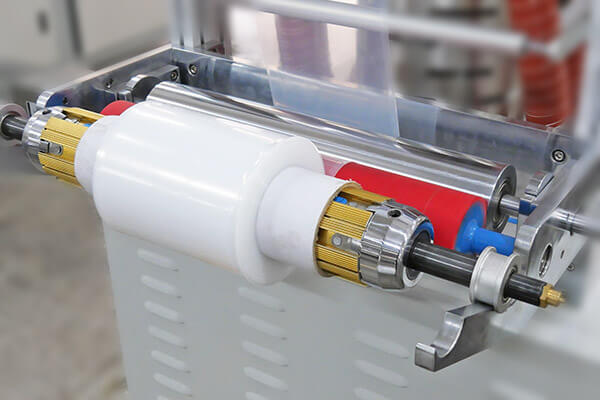
Winding unit
In addition to the commonly used single-layer film blowing machines, we can also provide multi-layer co-extrusion machines represented by three-layer co-extrusion film blowing machines. Co-extrusion is the simultaneous extrusion of multiple layers of materials.
This extrusion uses two or more extruders to melt and provide a stable volume throughput of different viscosities. The material is extruded through the die into the desired shape, and the layer thickness is controlled by the relative speed and size of the individual extruders.
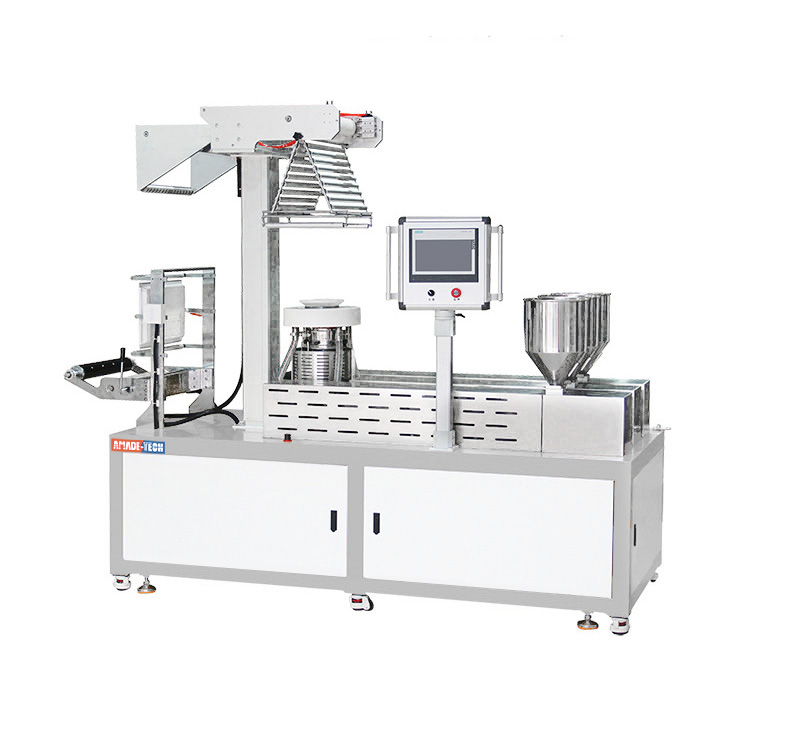
3-layer co-extrusion machine
Technical Parameters
| Model | AT-P6110-25 | AT-P6110-25-3 |
| Name | Singe-layer film blowing machine | Three-layer co-extrusion film blowing machine |
| Screw diameter | 25 mm or specified | 25 mm x 3 pieces or specified |
| L/D of screw | 33:1 or specified | |
| Screw speed | 0~95 rpm frequency control | |
| Motor | Variable frequency motor or servo motor | |
| Main motor power | 4 kW or specified | |
| Blowing fan | 0.25 kW or specified | |
| Die diameter | 25 mm or specified | 25 mm or specified |
| Max. Diameter of the produced film | 150 ~ 180 mm or specified | 300 mm or specified |
| Dimensions | 1800 mm (W) × 800 mm (D) × 2000 mm (H) | 2100 mm (W) × 950 mm (D) × 2300 mm (H) |
| Weight | Appr. 450 kg | Appr. 1100 kg |
| Power supply | 3∮,AC380 | |
Lab Film Blowing Machine Features
- Fabricated from rugged precision steel.
- Compact design saves space occupied in the laboratory.
- Easy for users to set up and use the machine.
- Equipped with a PLC touch screen control system to facilitate easy operation.
- Real-time running status of the machine can be monitored.
- Flexible configurations and options are available to meet different requirements.
- Built-in light source makes it easy for operators to check the quality of the blown film.
- Applicable to various polymer materials, such as HDPE, LDPE, LLDPE Blow film grade PP + Masterbatch, Filler Masterbatch, Plastic Additives, Functional Masterbatch.
- Internationally recognized parts are used to ensure the durability and stability of the machine.
Request a Quote Now
Please feel free to contact us for more details on the product, price, lead time, payment terms, shipment methods, etc. AmadeTech sales engineers will respond within one working day.