

Introduction
In the dynamic worlds of rubber and plastics, innovation isn’t just a buzzword – it’s the lifeblood of progress. From developing advanced materials for electric vehicles to creating more sustainable packaging solutions, the journey always begins in the research and development lab. At the heart of much of this crucial early-stage work lies a surprisingly fundamental yet incredibly powerful piece of equipment: the lab-scale two-roll mill. Often underestimated for its seemingly simple design, this versatile machine is far more than just a mixer; it’s an indispensable tool that empowers scientists and engineers to transform raw polymers and additives into the high-performance materials of tomorrow. This post will explore why the lab-scale two-roll mill is not just a piece of equipment, but an essential cornerstone for efficient and effective R&D in both the rubber and plastics industries, paving the way for groundbreaking discoveries and product enhancements in polymer processing, material science, and compound development.
What Is a Lab-scale Two-Roll Mill?
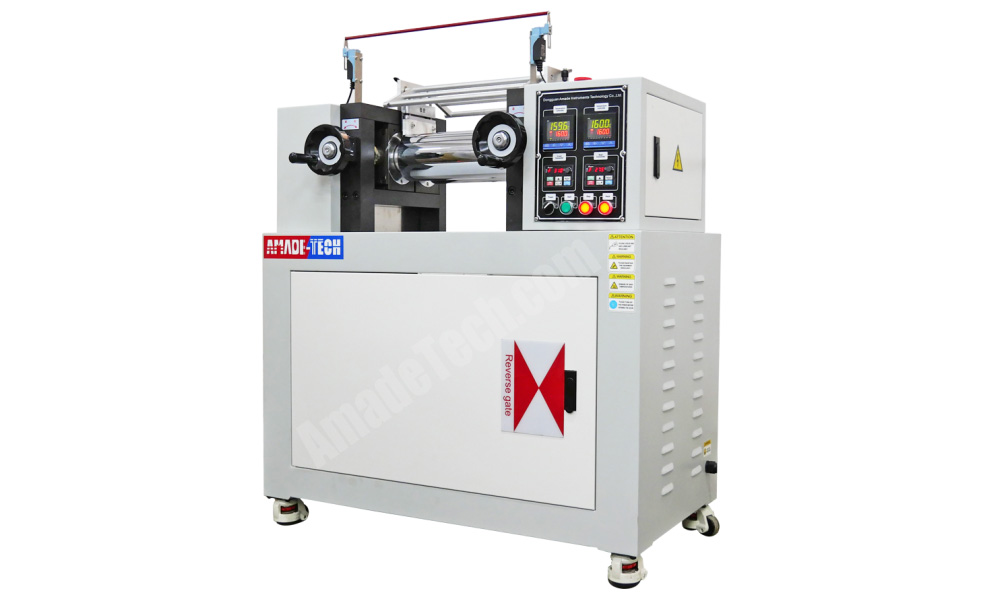
A two-roll mill (also known as an open roll mill or laboratory mixing mill) is an intermittent mixing device used for processing polymer materials such as rubber and plastics through plasticizing, mixing, and sheeting. Its core function is to apply shear and extrusion forces to the material through two horizontally arranged rolls rotating inwardly towards each other at different speeds, achieving uniform mixing and control of the material’s physical properties. It is the most basic and traditional polymer mixing equipment in the rubber and plastics industry.
Compared to production-grade two-roll mills, laboratory-grade two-roll mills are significantly characterized by smaller rolls and machine dimensions, resulting in lighter weight and a smaller footprint, making them suitable for small-batch mixing, multi-batch processing, and saving materials. Furthermore, because laboratory two-roll mills are primarily used for formulation development, incoming material inspection, and small-batch polymer production, the temperature control precision and surface finish of the rolls are far superior to those of production-scale two-roll open mills, ensuring high-quality material characterization and R&D applications.
What Is the Operating Principle of a Two-Roll Mill?
Polymers or materials mixed with various additives in a specific ratio are fed between the two rolls and piled over the gap. The two rolls rotate inward toward each other at different speeds. Under the action of friction and adhesion, the material is drawn into the gap. Because of the friction ratio between the front and rear rolls, the material is subjected to strong compression and shearing forces as it passes through the gap. The shearing force breaks the molecular chains of the material and generates a large amount of heat, softening the material. The material is pressed into sheets and coated on the rolls. Through manual operation or a turning device, the material is repeatedly cut, folded, and turned, ultimately breaking down the macromolecular chains to complete the plasticizing of raw rubber or to achieve uniform dispersion of the various components (polymers, fillers, additives) of the plastic material. This process is crucial for compound homogenization, material dispersion, and optimizing polymer rheology.
Why Are Laboratory Two-roll Mills Indispensable for Rubber and Plastics R&D?
A Precise Simulation of a “Miniature” of Large-Scale Industrial Production
The ultimate goal of research and development is to achieve mass production. The laboratory open mill, through controllable roll gap, roll speed ratio, temperature, and mixing time, can highly replicate the shear force field and thermal history experienced by materials in a continuous mixing production line. This makes it an ideal tool for process simulation and material scale-up studies.
For rubber: It can simulate the complete pre-vulcanization mixing process of natural rubber, from roll wrapping, cutting, folding to thin sheet producing. This is crucial for rubber compound development and elastomer processing.
For plastics: It can simulate the plasticizing, compounding, and fiber/filler orientation processes of rigid PVC, modified engineering plastics, or thermoplastic elastomers in the molten state. This directly supports polymer blend development and composite material research.
Ultimate Process Visualization and Flexible Intervention
Compared to the “black box” operation of a Banbury mixer, a laboratory open mill is completely open, offering unparalleled visual control in polymer R&D.
Observation Window: R&D personnel can observe key behaviors of the material in real time, such as roll wrapping, powder absorption rate, melting state, dispersion uniformity, and the presence of scorching. This intuitive data is the most direct basis for formulation design (such as lubricant dosage and crosslinking agent activity assessment) and process optimization. It’s vital for quality control and material analysis.
Dynamic Adjustment: During the mixing process, engineers can stop the machine at any time to take samples or manually intervene based on the material’s condition (such as manual rubber cutting, turning, and temperature adjustment). This flexibility is unavailable in large, enclosed equipment, making it superior for rapid prototyping and experimental flexibility.
Meeting the R&D Characteristics of Small Batches and Multiple Formulations
Laboratory research involves extensive formulation screening and orthogonal experiments. The characteristics of a laboratory open mill perfectly meet these needs for efficient R&D.
Minimum material usage: Typically, only 50 grams to 1 kilogram of material is required for a single mixing step. For expensive specialty rubbers, high-performance engineering plastics, or formulations containing nanomaterials or rare additives, this low barrier to entry is key to cost control and sustainable material development.
Thorough cleaning: The open mill’s simple structure and smooth roll surfaces facilitate thorough cleaning without any blind spots. This is crucial for research scenarios requiring frequent changes to different colors or substrates (such as switching from black conductive adhesive to white medical adhesive), effectively preventing data distortion caused by cross-contamination in polymer laboratories.
What Are the Advantages and Disadvantages of a Lab Two Roll Mill?
In modern industrial laboratories, open mills are typically used in conjunction with internal mixers. Compared to internal mixers, their main advantages are as follows:
High Flexibility
Laboratory open mills require only tens of grams of material per test, making them ideal for small-batch, multi-variety formulation development and modification testing of expensive materials or rare additives, enabling agile R&D.
Visualization
Operators can directly observe the changes in the material’s state on the rolls: whether it wraps around the rolls, whether the melting and plasticizing are uniform, the filler infeed speed, and whether stratification occurs during dispersion. Operators can adjust machine parameters at any time as needed, such as roll temperature, roll speed, and roll friction ratio, simulating a wide process window from low-temperature shearing to high-temperature plasticizing. This intuitiveness is crucial for formulation development and process parameter optimization.
Versatility
The laboratory open mill is not only a mixing device but also a sheeting device. Developed materials can be directly pressed into standard thickness test sheets on the open mill for subsequent vulcanization characteristic testing, mechanical property testing, or aging testing, eliminating the need for an additional sheeting process in material preparation.
Ease of Cleaning
Compared to enclosed equipment such as internal mixers, the open mill has an open structure, facilitating the cleaning of residual materials and avoiding cross-contamination between different formulations, which is critical for experimental integrity.
Suitable for Heat-sensitive and High-shear-sensitive Materials
The two rolls acting on the material during operation of an open mill have an exposed, open structure, which allows for rapid heat dissipation. Through precise roll temperature control (especially cooling capacity) and adjustable speed, the open mill can provide a “low-temperature, slow-speed, high-intensity dispersion” processing environment for temperature-sensitive materials such as fluororubber and chlorinated polyethylene, preventing scorching or degradation of the material in a confined, high-temperature environment. This makes it ideal for polymer degradation studies and material stability testing.
Every piece of equipment has its pros and cons, and the two-roll mill is no exception. Its disadvantages include:
Operational Safety Risks
Laboratory two-roll mills are considered high-risk equipment. Operators are in close proximity to the high-temperature, rotating rolls. Although laboratory models are typically equipped with safety levers or emergency stop devices, a high level of operator skill and concentration is still required. Operator violations of procedures (such as not wearing gloves or crossing safety lines) can easily lead to serious crushing injuries or hand entanglement accidents. This highlights the importance of safety protocols in polymer labs.
Environmental Pollution and Material Exposure
When adding powdered fillers (such as carbon black, silica, or small particles), the open rolls easily cause dust dispersion, affecting the experimental environment and causing slight errors in the actual feed ratio. For certain low-melting-point plastics or adhesives, severe wrapping of the front or rear rolls can easily occur on the open mill, even causing the material to stick and become unusable, which is difficult to handle. This can impact material yield and experimental accuracy.
High Labor Intensity for Operators
Compared to internal mixers, which rely entirely on automated mixing, two-roll mills depend entirely on manual operation. Actions such as feeding, cutting, turning, and folding the rubber require a high level of physical strength and operational skill from the operator, impacting laboratory efficiency.
Batch-to-Batch Variations
Due to the numerous variables inherent in manual operation, the reproducibility of different batches may be lower than with fully automated internal mixers, posing a challenge for process consistency and data reliability.
Limited Dispersion
For high-hardness rubber compounds or high-filler formulations, the dispersion effect of open mills is not as good as that of closed internal mixers, which is a consideration for nanocomposite dispersion and high-performance compound preparation.
What Are the Applications of Lab-scale Two-roll Mills in the Plastics Industry?
Plasticization and Rheological Behavior Research
By observing the melting, flow, and roll-wrapping behavior of plastics (such as PVC and PE) on heated rolls, the processing performance of different resin grades can be directly evaluated, preparing for subsequent testing. This is fundamental for polymer rheology studies and material flow analysis.
PVC Dynamic Aging Test
We can conduct PVC dynamic aging tests to screen heat stabilizers for rigid PVC formulations. Before the test, the roll temperature and roll spacing are set to a fixed value, following the same formulation. Then, heat stabilizers from different manufacturers in different proportions are added to different batches of the test. By sampling at specified time intervals or observing the color change time and degree of the material on the open mill, the effectiveness of different stabilizers can be quickly determined, supporting polymer stabilization research.
Formulation Screening and Optimization
When developing a new formulation, such as masterbatch, filled modified PP (e.g., with the addition of calcium carbonate and talc), or blended metals (e.g., PC/ABS), a large number of parallel experiments are needed on an lab two-roll mill with very small amounts of material (usually tens to hundreds of grams) to quickly screen out the optimal types and proportions of additives. This is vital for new material development and compound optimization.
Filling and Reinforcement Modification
It can be used to uniformly disperse various functional fillers into a plastic matrix. For example, it can be used to prepare highly filled PP/calcium carbonate composites or glass fiber reinforced PP/glass fiber systems, and to study the dispersion effect of the fillers and their impact on material properties, critical for composite manufacturing and performance enhancement.
Blending and Alloying
This involves “forced mutual compatibility” between two or more incompatible polymers through the strong shearing of a two-roll mill to prepare polymer alloys. A typical example is the use of a two-roll mill to prepare NBR/PA12 thermoplastic vulcanizate (TPV), a novel elastomer material with excellent performance, advancing polymer blend technology.
Functional Masterbatch Preparation
It can uniformly disperse high concentrations of additives (such as pigments, flame retardants, and antibacterial agents) in a carrier resin to prepare color masterbatches or functional masterbatches. The open mill allows for direct observation of pigment dispersibility and tinting strength, crucial for color matching and additive dispersion studies.
Process Parameter Optimization
By adjusting the open mill’s roll temperature, roll gap, speed ratio, and mixing time, process parameters for subsequent industrial production (such as calendering, extrusion, and injection molding) can be simulated and optimized to identify optimal processing conditions, forming a bridge from lab to production.
Standard Test Sample Preparation
This is a critical step in the R&D process. The mixed materials are pressed into uniformly thick sheets on the lab two-roll mill, which can be directly cut for subsequent mechanical property testing (such as tensile strength and elongation at break), optical property testing (such as light transmittance and haze), or aging resistance testing, essential for material certification and quality assurance.
What Are the Applications of Lab-scale Two-roll Mills in the Rubber Industry?
Masticating of Raw Rubber
A laboratory rubber mill can easily achieve small-batch plasticizing of raw rubber. Two inwardly rotating rolls at different speeds generate strong shear forces that break down the large molecular chains of rubber, transforming the raw rubber from a highly elastic state to a more pliable, malleable state, facilitating subsequent processing. This is a core step in elastomer processing.
Rubber Mixing and Formulation Research
A laboratory rubber mill can achieve uniform mixing of rubber raw materials. It can evenly mix raw rubber, fillers (such as carbon black), vulcanizing agents, and other different components. Small-batch production of different formulations can be easily achieved, allowing for comparison of finished products. By adjusting parameters such as roll gap and rotation speed, the dispersion degree of fillers can be controlled, which is crucial to the mechanical properties of the final product, directly impacting rubber compound performance.
Sheet Production and Sample Preparation
Developed materials need to be made into standard test sheets before vulcanization testing, tensile testing, or aging testing. The open mill is the most direct equipment for producing sheets of uniform thickness. Thanks to its open structure and excellent heat dissipation, it can press the mixed rubber compound into sheets of standard thickness without scorching, for subsequent testing of physical properties such as tensile strength, hardness, and abrasion resistance, essential for rubber material characterization.
Process Optimization: The Bridge Between Laboratory and Factory
Determining the optimal mixing process: Studying the impact of parameters such as roll gap, roll speed, mixing temperature, and time on rubber compound properties. For example, while a small roll gap increases shear force and facilitates dispersion, it can easily lead to overheating of the rubber compound; however, by precisely controlling the temperature difference between the front and rear rolls, stable coating of the rubber compound can be maintained. This laboratory data will precisely guide the factory in mass production.
Assessing Process Reliability
This involves “forced mutual compatibility” between two or more incompatible polymers through the strong shearing of a two-roll mill to prepare polymer alloys. A typical example is the use of a two-roll mill to prepare NBR/PA12 thermoplastic vulcanizate (TPV), a novel elastomer material with excellent performance, advancing polymer blend technology.
What Are the Differences Between Rubber Mixing Mills and Plastic Mixing Mills in a Laboratory?
Rubber and plastic are two completely different materials with distinct processing principles and temperature sensitivities. Therefore, the configuration and properties of the corresponding laboratory two-roll mills will differ significantly, mainly in the following aspects, which are critical for material compatibility and optimal processing.
Roll Surface Roughness
Rubber open mill rolls are chrome-plated with a specific roughness to promote gripping, while plastic open mill rolls are chrome-plated with a mirror finish.
When processing rubber, especially during plasticizing, due to the high elasticity and infusibility of raw rubber, if the rolls acting on the material are too smooth, slippage between the rolls and the material during compression and shearing can easily occur, leading to poor shearing performance or even preventing normal processing. This is vital for effective rubber mastication.
Plastic particles are completely different. They melt when heated and tend to stick to the rolls. Under shearing force, the molten material will adhere to the rolls. Using ordinary chrome-plated rolls would worsen this sticking problem and make post-processing cleaning difficult. The most reliable solution is to mirror-polish the roll surface, making it very smooth and shiny, reducing the possibility of material sticking. This enhances plastic sheeting and material release.
Rubber mixing mill
Friction Ratio and Roll Nip: The friction ratio of a rubber mixing mill is greater than that of a plastic mixing mill
Rubber is more resistant to shear force than plastic. Rubber has extremely high viscosity and requires strong shear force to break it down. Many plastics (such as PVC) are very sensitive to shear force; excessive shear can lead to molecular chain breakage or localized overheating and decomposition. Therefore, plastic mixing mills require less shear force. The core factors determining the machine’s shear force are the friction ratio and roll nip. Therefore, rubber mixing mills generally have a relatively high friction ratio, reaching 1.35:1, and the roll nip needs to be adjusted to a relatively small value before processing to generate strong shear force. Plastic mixing mills generally have a smaller friction ratio, such as 1.25:1, and a larger roll nip to prevent heat-sensitive materials from degrading due to excessive shear. This is key for polymer rheology control.
Plastic mixing mill
Temperature: Rubber mixing mills have cooling functions but no heating function; plastic mixing mills have heating functions but no cooling function
Rubber and plastic have completely different sensitivities to temperature. Most rubbers (especially uncured raw rubber) are very heat-sensitive; high temperatures can easily cause scorching, or premature vulcanization, rendering the material unusable. Therefore, strong cooling is essential during processing. This requires robust cooling systems for rubber processing.
Plastics, on the other hand, require sufficient heat to transform from a solid to a viscous fluid state, thus necessitating a heating system. Therefore, rubber mixing mill rolls generally do not require heating but must be equipped with cooling systems: typically using water or other media for cooling. Conversely, plastic mixing mill rolls must have heating capabilities reaching 250°C or even 300°C to melt plastic granules, and natural cooling is generally used. This highlights the importance of precise temperature control in polymer labs.
Motors: The motor power of a rubber mixing mill is significantly greater than that of a plastic mixing mill
Rubber exhibits extremely high viscoelasticity at room temperature or low temperatures, with tightly intertwined molecular chains and extremely high viscosity. This requires the rubber mixing mill motor to output enormous torque to overcome the resistance formed between the rolls, forcibly breaking the rubber molecular chains to complete mechanical plasticizing and mixing. We typically equip rubber mixing mills with two high-power motors for demanding rubber compounding.
Plastic mixing mills process molten materials. Their operating temperature is above the melting point, and the plastic has transformed into a viscous flow state, with strong free movement of molecular chains and a significant decrease in viscosity. The motor primarily overcomes the viscous resistance of the melt, requiring less power. We typically equip plastic mixing mills with one or two low-power motors, suitable for thermoplastic processing.
The Speed Difference Between the Front and Rear Rolls: In rubber open mills, the rear roll speed is greater than the front roll speed, while in plastic open mills, it’s the opposite
The speed difference between the front and rear rolls in an open mill is mainly determined by the different material properties of rubber and plastic. In the mixing process, after passing through the roll nip, plastic material tightly adheres to the slower roll, forming a continuous “rubber cloth,” making it easy for the operator to observe the compound’s state, add small amounts of material, cut and sheet the compound. If the rear roll is slower, the material may tend to adhere to it, severely interfering with operation.
In its molten state, plastic’s ability to adhere to metal rolls is far less than that of rubber; it doesn’t naturally stick to the rolls like rubber. The faster front roll and slower rear roll speed in a plastic open mill ensures that the molten plastic is carried away by the faster roll after passing through the roll nip, making it easier to adhere to the front roll, facilitating observation and operation by the operator. This design caters to distinct material handling characteristics.
Conclusion
As a fundamental piece of equipment in rubber and plastics material research and development, the laboratory two-roll mill provides a flexible, intuitive, and cost-effective platform for formulation development, process research, and quality control. Whether it’s masticating and mixing in the rubber industry or plasticizing and blending modification in the plastics industry, this machine acts as a “bridge” from the laboratory to the production line for polymer innovation.
However, rubber and plastics have drastically different processing requirements—rubber requires low-temperature, high-shear operation, while plastics require high-temperature, low-shear operation. Therefore, when purchasing a laboratory two-roll mill, it is essential to select the appropriate operating temperature range, friction ratio configuration, and motor power based on your primary processing target. If your laboratory involves both rubber and plastics research and development, it is recommended to choose a machine with independent frequency conversion speed regulation to flexibly switch friction ratios and adapt to the processing requirements of different materials. This ensures versatility in material testing.
If you are looking for a reliable and adaptable lab two-roll open mill for your laboratory, please contact AmadeTech Company for consultation. Our technical team can provide professional product selection advice and comprehensive technical support based on your specific material type and process requirements, helping your research and development work to be more efficient and smooth in advanced polymer research.
Leave Your Questions here